Ham Radio goes around the world, there are hams in every country.
All totaled, we are 3 Million strong.
Hams in the US have access to many (18) bands covering the entire spectrum
from below the AM BCB up to microwaves and beyond.
These bands are denoted as wavelength in Meters M (about 3 feet).
The bigger the number, the longer the wavelength and lower the frequency.
Without a license, you can listen all you want, but you can't transmit.
Once you get your first license and callsign, you can transmit all you want.
Not meant for music, transmitting music on HAM bands and CB is not a good idea.
To get your license, there is a test to pass and a fee to pay.
I've been licensed since the mid 80's, currently a "General."
The entry level is called "Technician." The test is not hard.
"General" is the mid level.
Then there's an Extra class.
Pass that test to get some additional frequencies and privileges.
YouTube has tons of ham radio content,
from getting your first license to some advanced stuff.
The ARRL is our national organization. Visit https://www.arrl.org
You will find plenty of good info there.
Just type in a search "ham radio license book," plenty of books to peruse.
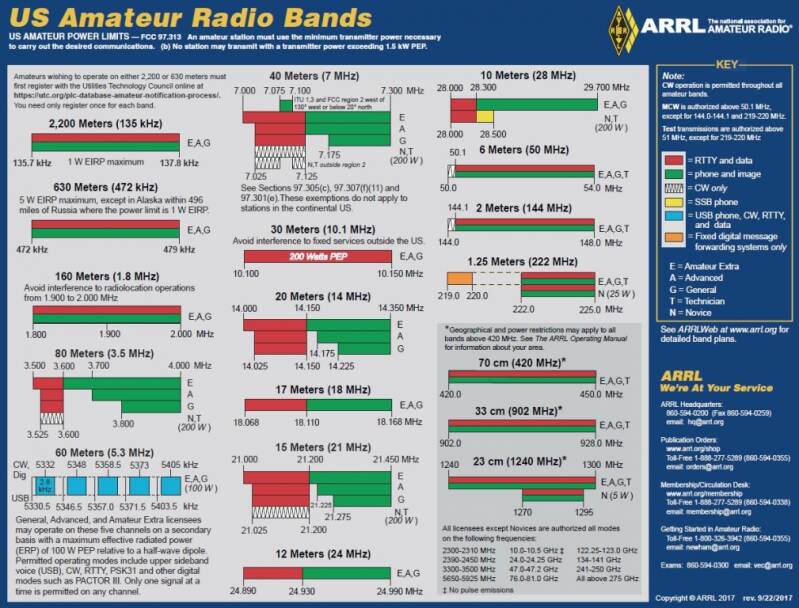
The chart below shows the bands in detail, some very narrow,
others have a generous frequency range.
The lower frequency bands need large antennas.
160, 80 and 40 Meter band antennas can get quite big,
good for HAMs with big back yards and bank accounts.
These low frequency bands can regularly go all around the planet.
HAMs in other countries enjoy getting to know their counterparts.
Like a mirror in the sky, these signals bounce off the ionosphere,
often called DX or skip.
10 Meters and on up can use more reasonable size antennas.
Under certain atmospheric conditions, 10 meters can also go very long distances,
though it's used locally as well.
I live on the 3rd floor of an apartment building.
My antennas are homebrew and located in the South facing windows.
The rest of this large building is all around my apartment,
makes for difficulty receiving and transmitting in any directions other than South.
The size of my antennas is limited by the size of the windows,
fortunately the windows are big enough and the antenna is good for
2M (144 MHz), 1.25M (220 MHz) and 70 cM (440 MHz).
It's a pizza pan broadband, non-resonant type of antenna.
To see some of these antennas, visit the ANTENNAS page.
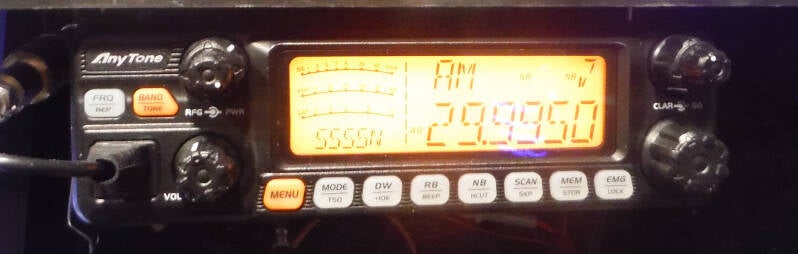
This is my AnyTone AT-5555 transceiver, used as a base station.
It covers 24.715 MHz to 30.105 MHz, the 12M, 11M and 10M bands.
I built a homebrew 10M antenna in a corner of the room.
It is too small to work on the lower frequency bands,
so I don't have a radio that has all the low frequency bands
as they are much more expensive and useless in this small apartment.
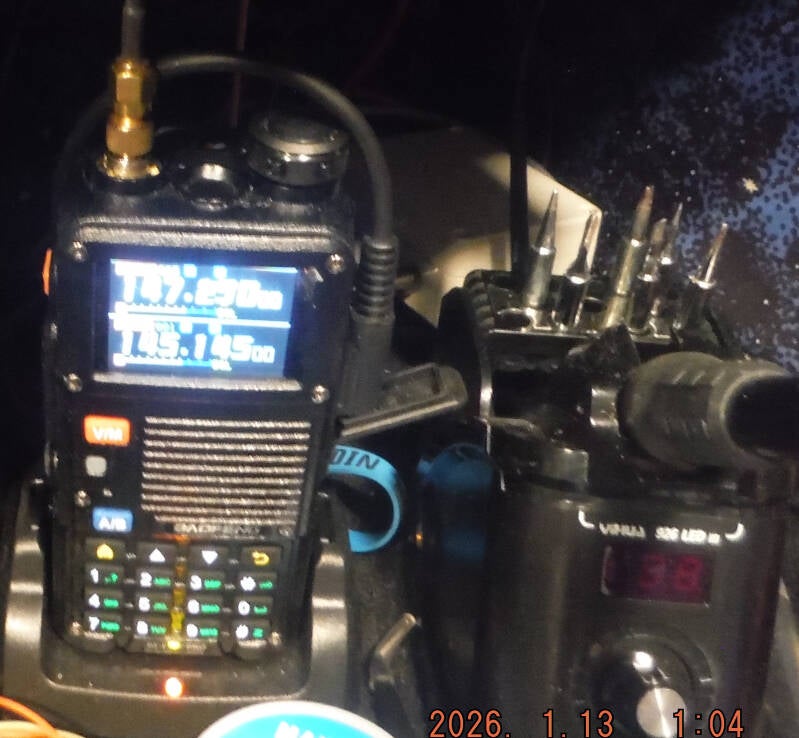
This is my Baofeng F8HP Pro triple band handheld transceiver sitting on it's charging stand.
I can take it in the car, connected to the tri band antenna on top of the car.
It has a USB charging port, makes it easy to charge while mobile.
I picked this one because it's a lot of radio for the buck.
At home, it is used as a base station, connected to the large pizza pan window antenna.
Visit ANTENNAS page to see these antennas.
It covers 144-148 MHz (2M), 222-225 MHz (1.25M) and 420-450 MHz (70 cM) HAM bands.
That's a whopping amount of spectrum space (37 MHz) in those 3 bands.
The Baofeng is an amazing radio.
They are well known for making a variety of affordable HAM radios.
It transmits on the HAM bands and receives 88-108 MHz FM BCB, 108-136 AM Air band,
136-174 MHz, 220-260 MHz, 350-390 MHz and 400-520MHz frequencies.
It has a VFO that can instantly go to any of those frequencies
using the keypad or up/down buttons.
It's Memory has hundreds of channels which can be programmed for all the local repeaters
and simplex channels using a free program called CHIRP.
It works like a spreadsheet, you enter the info for each channel,
hook up the radio to USB and send the data to the radio.
CHIRP makes it easy, is cross platform and will work on 99% of computers.
It covers hundreds of radio brands and models.
The radio can scan the channels you just programmed, stopping on a channel in use.
Next to it is a solder station.
This has been an example, just how I put my station together.
Hope it's helpful.